

Maths
Welcome to Mathematics: At Bussage we believe mathematics is a creative and highly inter-connected subject that is essential to everyday life. Embracing our vision of ‘Learning for life in all its fullness,’ Maths helps children make sense of the world around them, giving them a better understanding of its beauty and structure and allowing them to flourish. We strive to empower our children with a ‘Can do’ attitude to maths, creating an environment where they are confident to try new skills and build their understanding of this broad subject.
What is a mathematician?
At Bussage, we believe that to be a good mathematician, children need to build resilience and self-confident with the subject, becoming resourceful thinkers in the process. We aim to do this through developing our children’s fluency, reasoning and problem-solving skills:
- Fluency is the fundamentals of maths. Developing conceptual understanding and the ability to recall and apply knowledge rapidly and accurately. Learners are fluent when they choose appropriate methods to calculate answers efficiently. They are fluent when recall definitions and use number facts (for example, age -appropriate number bonds and times table facts). They are fluent when they use appropriate mathematical language.
- Reasoning is the ability is the ability to put the fundamentals into place and use them to investigate maths problems and communicate an answer. These include skills of analysing, proving, explaining, inferring, justifying and generalising. Learners show these skills when they explain their thinking. They show them when they transfer learning from one context to another. They show them when they prove something is true of false and when they compare and contrast related ideas and explain their choices.
- Problem-solving allows the children to deepen their learning and understanding of different concepts. Learners show good problem-solving skills when they choose appropriate methods to solve a problem. They show reasoning skills when they check that their answers are reasonable. They show reasoning skills when they use their fundamental skills in unfamiliar situations.
Future careers in maths
Mathematicians use lots of useful skills to solve problems and understand the world. They are good at thinking logically, spotting patterns, and working carefully with numbers. They also use creativity to find different ways to solve tricky problems. Being patient and not giving up is important, especially when problems take time to figure out. Mathematicians need good communication skills too in order to explain their ideas clearly.
Mathematicians can choose from many exciting careers. Some become teachers and help others learn. Others work as engineers, designing bridges, buildings, or machines. Mathematicians can be scientists, studying space, weather, or medicine. They might also work in finance, helping businesses manage money, or in technology, creating computer programs and games. Maths is useful in everyday life and opens the door to many interesting and important jobs.
Our core values in maths
The teaching of Maths at Bussage is guided by our four cornerstones:
- Hope: Maths helps identify problems and find solutions to difficulties faced in the world.
- Wisdom: Teaching us how to think carefully, spot patterns, and make connections.
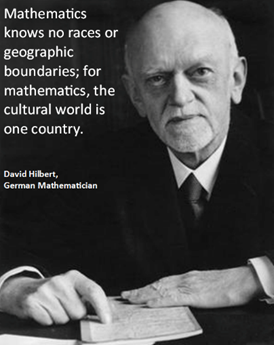
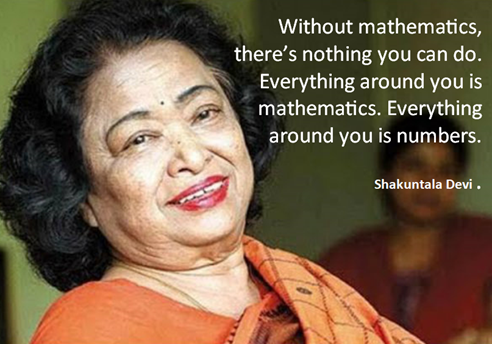
- Community: Fostering a sense of teamwork through the knowledge that the language of maths can be accessed and understood by all people.
- Dignity: Building an understanding that Maths is universal and treats all people equally.
 Through these values, we prepare our pupils for the next stages of their education, helping them to become critical thinkers with an array of skills that will help them to develop an understanding and joy of the world we live in
Join us on a journey of creativity and understanding, where each lesson helps to build a better understanding of our world.
Our Mathematics Curriculum
At Bussage, we are critical consumers of the maths curriculum provided by White Rose Hub. We use WRH for our long-term planning, ensuring all the objectives for a year group are covered. In order to tailor our curriculum to our children’s particular needs, class teachers use carefully selected resources from a number of high-quality providers and fit them into our lesson structure.
White Rose Hub Yearly overview
GLOW Maths
We have been involved with GLOW Maths Hub since the start of the 2024-25 academic year. These hubs are ran by maths experts and help schools to adapt and ensure maths is taught to the highest standard. Being part of this initiative has helped us to develop our teaching and learning at Bussage. More information about the GLOW Maths Hub can be found here:
Teaching for mastery
Bussage has adopted a Teaching for Mastery approach to mathematics to ensure that our children have a deep, long-term, secure and adaptable understanding of the concepts they are taught. In Years 1-6, teaching focuses on securing and deepening understanding of mathematical concepts. In Early Years the principles of the EYFS Framework are followed, and children ‘Explore Maths’ and develop their understanding of mathematical concepts through play. The phrase Teaching for Mastery describes the elements of classroom practice that combine to give children the best chances of mastering maths. Mastery is not just being able to memorise key facts and procedures and to answer test questions accurately and quickly. Mastery means being able to use prior knowledge appropriately, flexibly and creatively and to apply it in new and unfamiliar situations. The ability to solve problems in a range of contexts, to reason mathematically and to be fluent and confident with number and the number system is embodied in the aims of the National Curriculum and is at the heart of mastery.
Mathematic lessons
Children are taught through whole-class interactive teaching, where the focus is on all pupils working together on the same lesson content at the same time. Lesson design identifies the new mathematics that is to be taught, the key points, the difficult points and a carefully sequenced journey through the learning. It is recognised that practice is a vital part of learning, but the practice used is intelligent practice that both reinforces pupils’ procedural fluency and develops their conceptual understanding. After developing fluency, children need to show that they can apply their knowledge in mathematics and then move on even further to prove they have mastered the concept. Using mistakes and misconceptions is an essential part of learning and challenge is provided through rich and sophisticated problems.
A typical mathematic lesson design:
1) Hook: Generates discussion about the key learning point
2) Teach & Practise: Live modelling of the new learning with explicit use of potential misunderstandings following an ‘I do,’ ‘we do,’ ‘you do’ format.
3) Apply and deepen: Demonstrates the maths and language skills required to answer reasoning and problem-solving questions.
4) Hinge question: Allows for fluid grouping. Who understands? Who needs more support?
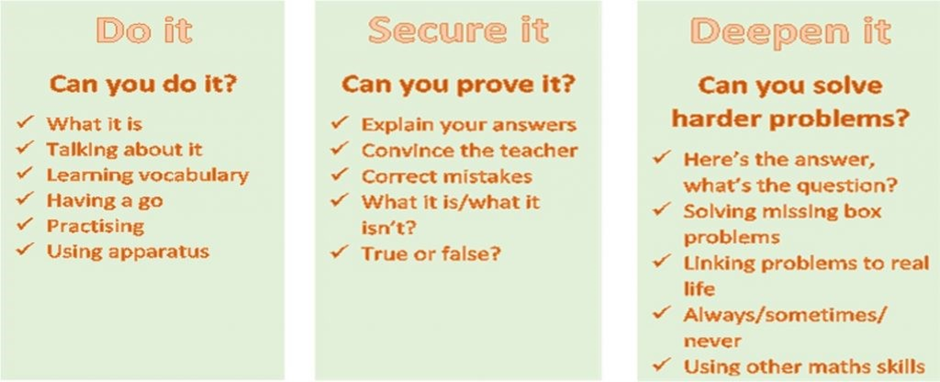
5) Do it!: This consists of up to five fluency-based questions incorporating procedural variation.
6) Secure it!: These are questions that bring in more of a reasoning element such as explaining a misconception using precise mathematical vocabulary.
7) Deepen it!: This is where children show their problem-solving skills by showing their understanding of an objective to solve new problems.
Maths in the early years
Maths in Reception focuses on building strong foundational knowledge and skills in number sense, counting, and shape recognition through play-based learning and practical activities. Children learn to count confidently to 20, understand "more" and "fewer," subitise (instantly recognise small amounts), and solve simple addition/subtraction problems.
We teach maths daily using the NCETM (National Centre for Excellence in the Teaching of Mathematics) and the White Rose Maths resources as a basis of our planning. These resources provide comprehensive, mastery-based schemes of learning for mathematics and promotes excellence in maths education.
Assessment in maths
Children are continually assessed against the key National Curriculum and Foundation Stage objectives for their year group.
Assessment for learning is the basis of effective classroom practice. At each stage of the lesson, our staff use elicitations and ongoing formative assessment to make decisions about the learning of each child; whether this be to support, consolidate or extend their learning. The use of the ‘you do’ and hinge questions ensures that learning is grasped.
In addition to the ongoing formative assessment during lessons and marking of work in books, we also use Testbase to provide summative assessment data. The children sit the tests at the end of terms 2, 4 and 6 - data from the tests is used alongside other evidence to make a summative teacher judgment of each child’s attainment at these points.
End of block and end of term judgments are recorded in the ‘insight’ assessment grid and tracker.
Times Table Rock Stars
Each child has their own personal log in to Times Table Rock Stars (TTRS) from Year 2, which can be accessed at school and at home.

Times tables are recognised as essential to access many mathematical concepts and knowledge will be assessed at the end of Year 4, by a National test.
- By the end of Year 2, children are expected to recall and use multiplication and division facts for the 2, 5 and 10 multiplication tables.
- By the end of Year 3, children are expected to recall and use multiplication and division facts for the 3, 4 and 8 multiplication tables.
- By the end of Year 4, children are expected to recall and use multiplication and division facts for multiplication tables up to 12 x 12.
- In Years 5 and 6, children are expected to revise all times tables and division facts up to 12 x 12.
When it comes to times tables, speed and accuracy are important – the more facts children remember, the easier it is for them to solve harder calculations. Times Table Rock Stars is a fun and challenging platform designed to help children master the times tables.
Year 4 Multiplication Check. In June, the children in Y4 participate in the statutory multiplication tables check. The purpose of the check is to determine whether your child can fluently recall their times tables up to 12. It is an on-screen check consisting of 25 times table questions. Your child will be able to answer 3 practice questions before taking the actual check. They will then have 6 seconds to answer each question. On average, the check should take no longer than 5 minutes to complete.
We encourage your child to use their online Times Table Rock Stars account on a daily basis. This should be for no more than 5 minutes. It has an excellent track record for improving times table recall and is great fun! One of the excellent features of TTRS is the ‘Sound Check’. This is an online game set up in the same way as the MTC in June. Practising via ‘Sound Check’ will help children to prepare for the MTC.
Mathematics is an important creative discipline that helps us to understand and change the world. We want all pupils at Bussage to experience the beauty, power and enjoyment of mathematics and develop a sense of curiosity about the subject.
Fluency (Quickmaths)
In KS2, all children will receive a 15-minute Fluency lesson in addition to their main maths lesson. The aim of fluency lessons is for children to practise and consolidate number and calculation skills that have been previously taught. The focus on depth and mastery in our main maths lessons means that children may not practise certain skills for many weeks. Fluency lessons, therefore, ensure regular revision and consolidation of skills from across the maths curriculum. Fluency lessons may or may not link directly with the learning in the main maths lesson on a given day.
Recording of work in Fluency lessons will range from informal jottings to formal written calculations and will be done in a dedicated maths Fluency book - but there is no expectation that there will be recording during every lesson, especially if the lesson focuses on mental arithmetic.
The purpose of fluency lessons is to allow children to revisit, practise and remember more.
Maths toolkits
Throughout Key Stage 2, pupils have regular access to mathematics toolboxes, with approximately one toolbox shared between four children. These toolboxes contain a carefully selected range of mathematical tools and manipulatives that pupils may choose to use independently to support their learning. The contents are tailored to the mathematical concepts and representations most relevant to each year group, and explicit teaching ensures that pupils develop the knowledge and confidence to select and use resources appropriately.
The mathematics toolboxes complement the whole-class sets of manipulatives and apparatus, such as base ten blocks (Dienes), place value counters and plastic money, which teachers use purposefully within lessons. In line with the NCETM Five Big Ideas, particularly Representation and Structure, these resources are carefully chosen to expose mathematical structures, deepen conceptual understanding and support pupils in making connections between concrete, pictorial and abstract representations. Through consistent access to and use of these representations, pupils are encouraged to reason mathematically, communicate their thinking and develop greater independence in selecting effective strategies and tools to support their learning.
Still to come:
Maths environment in the classroom
Help for parents
Coming soon....
Useful links
Coming soon....